Queen Nefertiti was far more than a famous face, and you can still follow her trail across Egypt
Queen Nefertiti was far more than a famous face, and you can still follow her trail across Egypt
Queen Nefertiti was the Great Royal Wife of Akhenaten, the pharaoh who set aside Egypt's old gods for the sun disc Aten in the fourteenth century BC and built a new capital at Amarna. She had six daughters with him, appears in temple scenes doing a king's work, and may have ruled in her own right after he died, though that is a theory, not a settled fact. Her painted bust, found by a German team at Amarna in 1912, sits in Berlin. Her tomb has never been identified. In Egypt you can still walk her city, see her temple blocks in Luxor and stand in front of her unfinished portraits in Cairo. Here is how.
Who Nefertiti was, in plain terms
Her name means "the beautiful one has come," and it was almost certainly given at birth, so it says nothing about her looks. She married Amenhotep IV early in his reign, in the middle of the fourteenth century BC, late in the Eighteenth Dynasty.
Where she came from is not known. The most common suggestion makes her a daughter of the courtier Ay, because Ay's wife Tey was called nurse to the Great Royal Wife. An older idea made her a princess from Mitanni. Neither can be proven, and an honest guide will say so.
What the record does show is her rank. She held the title Great Royal Wife from the start, and within a few years the king added a second name to hers, Neferneferuaten. Among the pharaohs and queens of the Nile, few women are named so often on temple walls. The last dated mention of her, a quarry inscription from Akhenaten's sixteenth year, shows she was alive and still queen near the end of his reign.
Akhenaten, the Aten and the Amarna revolution
To understand Nefertiti you need her husband. Amenhotep IV inherited the richest kingdom of its age, where the god Amun of Thebes and his priesthood controlled vast estates. Within a few years he renamed himself Akhenaten and promoted the sun disc as the one god worth worshipping, shown as a disc whose rays end in small hands offering life.
He first built open-air temples to the Aten at Karnak. Then, around his fifth year, he founded a new city on empty ground in Middle Egypt and called it Akhetaten, "horizon of the Aten." We know it as Amarna.
The art changed with the religion. Figures were drawn with long faces and swelling hips, and for the first time the royal family appears at home, kissing daughters beneath the Aten's rays. Nefertiti is in almost every one of these scenes, beside the king rather than behind him, often the same size.
The experiment lasted about seventeen years. After Akhenaten died the court returned to Thebes under Tutankhamun, the city was abandoned, and later kings chiselled the family's names off monuments, which is why Nefertiti's final chapter is so hard to read.
Six daughters and a queen who did a king's work
Nefertiti and Akhenaten had six daughters, named on the reliefs in order of birth. No son is ever shown with her; Tutankhamun is a son of Akhenaten by another woman according to the DNA study of the royal mummies.
- Meritaten, the eldest, later became a queen herself, married to the shadowy king Smenkhkare.
- Meketaten died as a girl; the Royal Tomb at Amarna shows her parents grieving over her.
- Ankhesenpaaten became Ankhesenamun and married Tutankhamun.
- Neferneferuaten Tasherit, Neferneferure and Setepenre fade from the record in the last years at Amarna.
What sets Nefertiti apart is what she is shown doing. On the Karnak temple blocks she offers to the Aten alone, without the king. On one block she swings a mace over a kneeling captive, the smiting pose that belonged to pharaohs. One Karnak building was decorated almost entirely with her image.
Egyptologists argue about how much real power that reflects, but nobody argues that it was normal. Hatshepsut needed a king's titles and a false beard to rule; Nefertiti did a king's work while shown as a woman.
The Berlin bust and what Borchardt found in 1912
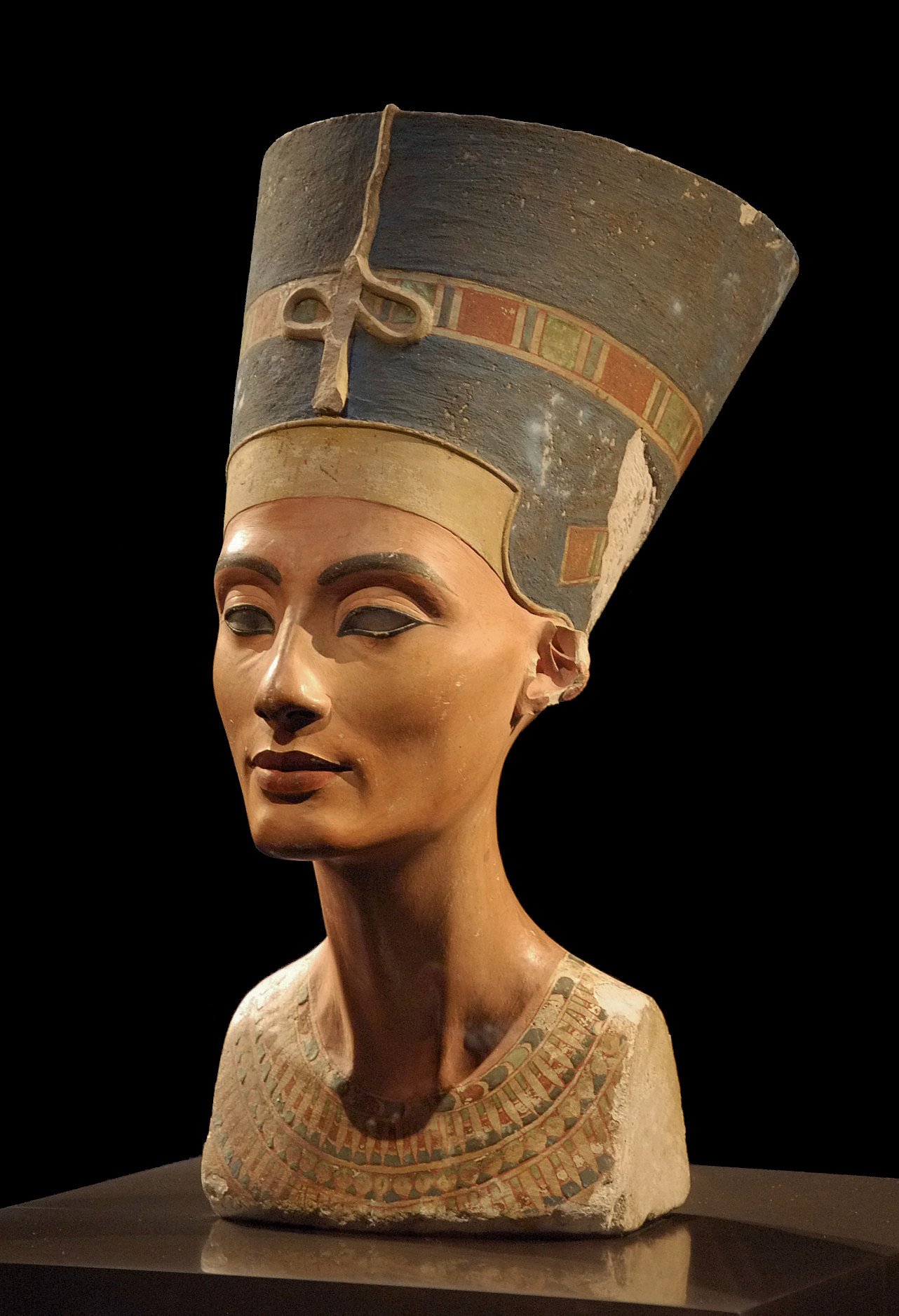
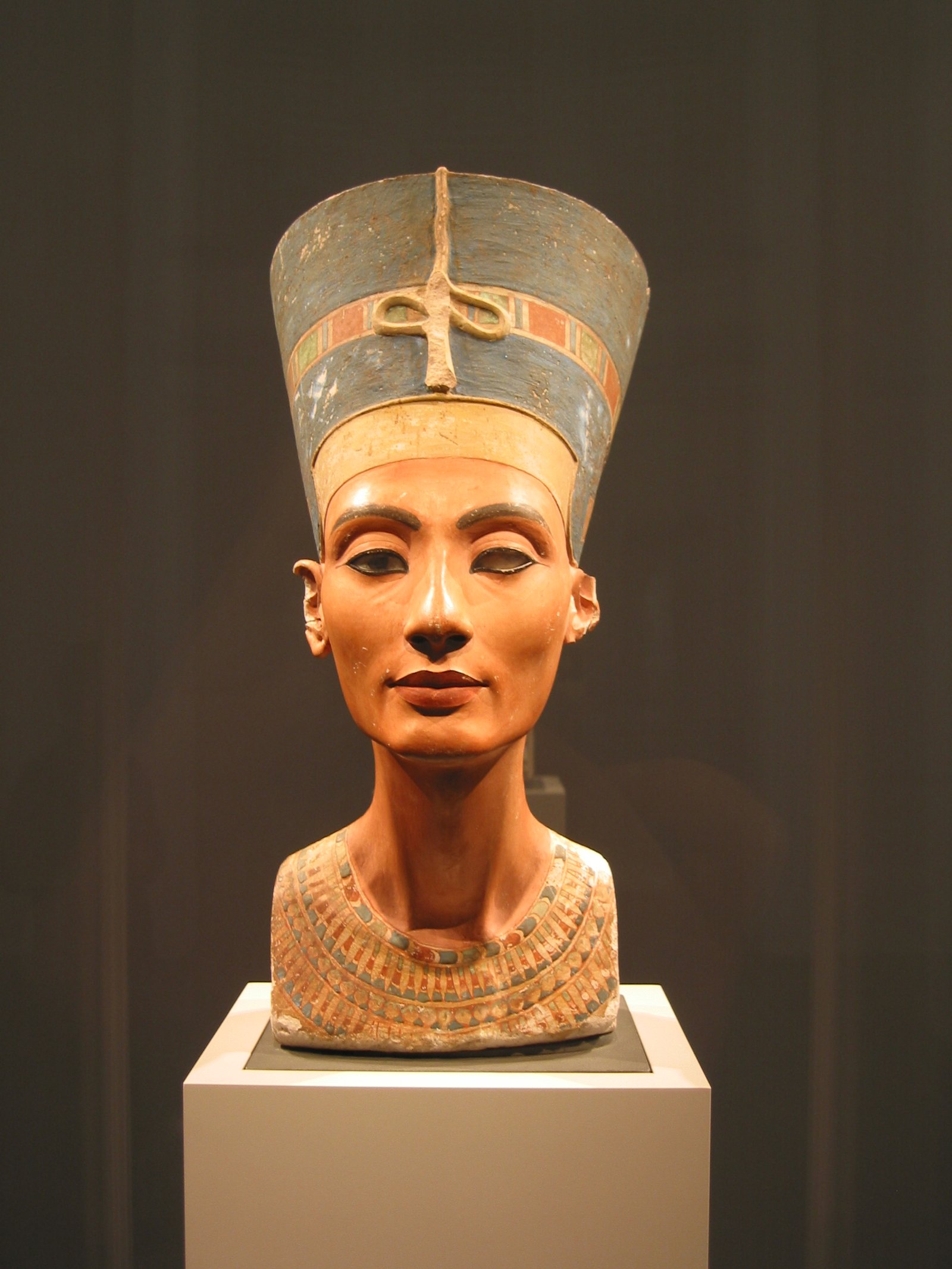
On 6 December 1912 a team of the German Oriental Society, directed by the architect and Egyptologist Ludwig Borchardt, was clearing a house in the southern suburb of Amarna when a painted bust of a queen turned up face down in the rubble. Borchardt's diary note that evening said, in effect, that description was pointless.
The house belonged to a sculptor named Thutmose, identified from an ivory horse blinker inscribed with his name. His workshop also yielded plaster faces of courtiers and unfinished heads of princesses, which is why the bust is read as a studio piece.
Finds were then divided between the excavating mission and the Egyptian Antiquities Service, run at the time by French officials. In the division of January 1913 the bust went to the German share and travelled to Berlin, where the dig's sponsor, James Simon, later gave it to the Prussian state. It went on public display in 1924 and today stands alone in a domed room of the Neues Museum. It is about 19 inches tall, roughly 48 centimeters.
Why the bust looks as if it were made yesterday
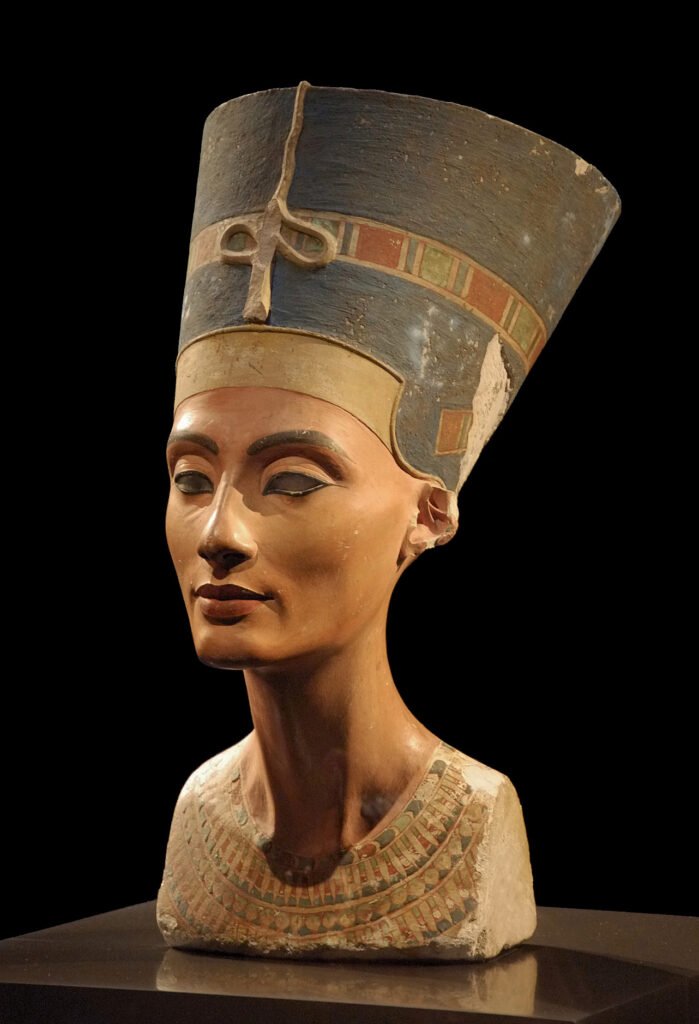
The core is limestone, but the surface is a skin of gypsum plaster, laid on in layers and modelled while soft, which gives the long neck and the jaw a softness carved stone rarely achieves. The paint, mineral pigments over the plaster, is original, not a modern restoration.
A CT scan in Berlin showed that the limestone face beneath the plaster is subtly different: creases beside the mouth, a small bump on the nose, less symmetry. The sculptor started from a realistic likeness and idealized it in plaster. Both faces are still there, one on top of the other.
The left eye was never inlaid. The right has a quartz inlay; the left socket is bare, with no trace of adhesive. The most accepted explanation is that this was a workshop model, a reference for other sculptors to copy proportions from, so the second eye was never needed. If that is right, the most famous face from Egypt is a working tool.
The repatriation debate, stated as fairly as we can
Egypt has asked for the bust more than once, most formally in the years around 2011, and Germany has declined each time.
The Egyptian case. Critics say the quality of the piece was not made clear to the official who approved the division, that the photograph in the record showed it poorly, and that an object of this rank should have stayed in Cairo. The export was legal on paper, on this view, but not in spirit.
The German case. The division was made by the competent authority of the time, was documented, and was not contested for decades. The museum also argues that the plaster skin is too fragile to travel.
The file has been published and historians still read it differently, which is why the question is not closed after a century. It sits alongside the Rosetta Stone in London in the wider debate about Egyptian objects in European museums.
How her story ends: the theories, presented as theories
After Akhenaten's year 16 Nefertiti vanishes from dated records, and two shadowy rulers appear before Tutankhamun: a king called Smenkhkare, married to Meritaten, and a ruler named Ankhkheperure Neferneferuaten, written with feminine grammatical forms in several places.
- Nefertiti became pharaoh. Because her own second name was Neferneferuaten, many Egyptologists identify the female ruler with her, as co-regent beside her husband or briefly alone after him.
- Meritaten became pharaoh. Others argue the female Neferneferuaten was the eldest daughter, promoted after her mother's death.
- Nefertiti was Smenkhkare. An older theory, less favored now, made both shadowy kings one person, and that person Nefertiti.
- She died as a queen. A minority view keeps her a consort to the end, buried at Amarna and perhaps moved later to Thebes.
The evidence is a handful of damaged inscriptions, a few objects reused in Tutankhamun's tomb that carry Neferneferuaten's name, and grammar. Documentaries pick one answer; a good guide gives you all four.
The search for her tomb and the KV62 scans
Neither Nefertiti's tomb nor her mummy has been securely identified. Two lines of inquiry get most of the attention.
The Younger Lady. A female mummy from a side chamber of tomb KV35 was proposed as Nefertiti in 2003, on the basis of a shaved head, a double ear piercing and the position of one arm. The 2010 DNA study identified her as the mother of Tutankhamun and a daughter of Amenhotep III and Tiye. Most specialists read that as ruling Nefertiti out; a few disagree.
The hidden chambers of KV62. In 2015 the Egyptologist Nicholas Reeves proposed, from scans of the painted walls, that Tutankhamun's tomb had been cut as a larger tomb for Nefertiti, with sealed doorways behind the north and west walls. Radar surveys followed: the first suggested voids, a second was inconclusive, and a third, by an Italian university team in 2018, found no evidence of hidden rooms, after which the antiquities authorities declared the matter closed. Reeves still argues from the paintings. Nothing has been excavated and no chamber has been found. You can stand in that room yourself; see our guide to Valley of the Kings tickets and tombs.
The Royal Tomb at Amarna, where fragments of a funerary figurine with her name were found, is the other candidate. If a headline claims she has been found, check whether anyone has opened a door. So far nobody has. For a sober view, read our note on recent archaeological discoveries in Egypt.
Nefertiti or Nefertari? Two queens people mix up
Every week someone asks us to see "Nefertiti's tomb in the Valley of the Queens". Those belong to Nefertari, a different woman who lived more than a century later.
| Nefertiti | Nefertari | |
|---|---|---|
| Husband | Akhenaten | Ramesses II |
| Dynasty and period | Eighteenth, mid fourteenth century BC | Nineteenth, thirteenth century BC |
| Home city | Amarna | Thebes and Pi-Ramesses in the Delta |
| Best known for | The Berlin bust and the Aten religion | The painted tomb QV66 and the small temple at Abu Simbel |
| Tomb | Never identified | Valley of the Queens, Luxor west bank |
| Where you meet her | Amarna, the Luxor Museum, the Cairo museums | Valley of the Queens and Abu Simbel |
If your trip includes the Luxor west bank and a visit to Abu Simbel, you will meet Nefertari properly.
What you can actually see today: Amarna and the Royal Tomb
Amarna lies on the east bank of the Nile in Minya governorate, roughly 190 miles, about 300 kilometers, south of Cairo. The city was built fast in mud brick and abandoned within a generation, so what survives is low: foundations, column bases and the outline of streets between the river and a semicircle of cliffs. It takes imagination and a guide who can read a ground plan out loud.
- The North Tombs, cut into the cliff, where Huya, Meryre and Panehesy show the royal family in procession, Nefertiti in her own chariot.
- The South Tombs, including the tomb of Ay with the fullest copy of the Great Hymn to the Aten. Which tombs are open varies.
- The Great and Small Aten Temples, marked out at ground level with modern column stubs.
- The North Palace, long linked to Nefertiti, with its garden court.
- The Royal Tomb, several miles up a dry valley east of the city, where the mourning scenes for Meketaten survive. Access has varied over the years and we check it before you go.
- The boundary stelae, the northern one reachable by vehicle.
Amarna is quiet; on many days you will be the only visitors at what was, for seventeen years, the capital of Egypt.
Luxor, Karnak and the Cairo museums
The Luxor Museum. The best place in Egypt to see Nefertiti at work is the reconstructed wall of talatat in the Luxor Museum. Talatat are the small standard blocks Akhenaten used so his Karnak temples could rise quickly; later kings packed them inside their own pylons as fill. Decades of matching produced a jigsaw of the Aten temples, and the museum displays one long section with Nefertiti and Akhenaten offering beneath the disc. Give it an hour on your Luxor east bank and west bank days.
Karnak. Nothing of the Aten temples stands at Karnak. What you can see is where the blocks were hidden: the Ninth Pylon, from whose fill thousands of talatat were recovered.
Cairo. The Egyptian Museum in Tahrir Square has long held the Amarna room: colossi of Akhenaten from Karnak, a stela of the family beneath the Aten, and an unfinished quartzite head of Nefertiti with the sculptor's guidelines still drawn in black on the stone. Many visitors find it more moving than the finished bust. Pieces move between Tahrir and the Grand Egyptian Museum at Giza, so we check which building holds them the week you travel.
How Explora Egipto builds an Amarna day from Minya or Cairo
Amarna is not on the standard Cairo, Luxor and Aswan circuit, which is exactly why people who care about Nefertiti want it.
| Day trip from Cairo | Overnight in Minya | |
|---|---|---|
| Driving | About four hours each way | Under an hour from Minya to the site |
| Time at Amarna | Three to four hours | A full day, Royal Tomb included |
| Add-ons | None realistic | Beni Hasan, Tuna el-Gebel, Hermopolis |
| Best for | One spare Cairo day and a strong back | Anyone who wants the Amarna period properly |
| Where you end | Back in Cairo late evening | Cairo, or onward south by road |
From Cairo. We leave at first light in a private vehicle with an Egyptologist guide, cover the North Tombs, the temples and the North Palace, and have you back in Cairo for a late dinner. It is twelve to fourteen hours door to door.
From Minya. We drive down the afternoon before, sleep in Minya on the river, and start Amarna fresh. The second day adds Beni Hasan and Tuna el-Gebel with its ibis catacombs. Middle Egypt has its own arrangements for foreign visitors and they change; we handle permits and escorts where required.
Either version slots into a custom Egypt tour: the Cairo museums, then Amarna, then Luxor for the talatat wall, Karnak and the Valley of the Kings. Ask us for the quote.
Frequently asked questions
Was Nefertiti a pharaoh?
Possibly, but it is not proven. A ruler named Ankhkheperure Neferneferuaten, written with feminine forms, reigned briefly between Akhenaten and Tutankhamun, and because Nefertiti carried the name Neferneferuaten many Egyptologists identify that ruler with her. Others make it her daughter Meritaten. The evidence is thin and the debate is open.
Where is the bust of Nefertiti today?
In the Neues Museum on Museum Island in Berlin, displayed alone in its own domed room. It left Egypt in 1913 under the division of finds that governed foreign excavations then. There is no original in Egypt, only copies, but Cairo has the unfinished quartzite head from the same workshop, which many visitors prefer.
Has Nefertiti's tomb been found?
No. Neither her tomb nor her mummy has been securely identified. The Younger Lady mummy from KV35 was proposed as her, but DNA work identified that woman as a daughter of Amenhotep III, which most specialists consider incompatible. Radar surveys of Tutankhamun's tomb gave conflicting results and the last found nothing.
Are Nefertiti and Nefertari the same person?
No. Nefertiti was the wife of Akhenaten in the fourteenth century BC and lived at Amarna. Nefertari was the wife of Ramesses II more than a century later; her painted tomb is in the Valley of the Queens and her small temple stands at Abu Simbel. The famous bust is Nefertiti; the famous tomb paintings are Nefertari.
Can you visit Amarna as a tourist?
Yes, with private transport and a guide. Amarna is in Minya governorate, around 300 kilometers south of Cairo, and can be done as a very long day from the capital or, better, with an overnight in Minya that also covers Beni Hasan. Arrangements for foreign visitors change, so we organize the permits and any escort as part of the trip.
Is Nefertiti's mummy on display anywhere?
No mummy is confirmed as hers. The Younger Lady from KV35, the candidate most often mentioned, is displayed among the royal mummies at the National Museum of Egyptian Civilization in Cairo, labelled by her tomb rather than by a name. Seeing her is worth it, as long as you know the identification is disputed.
Follow Nefertiti from Cairo to Amarna to Luxor
Tell us your dates, whether you want Amarna as a day from Cairo or a night in Minya, and how deep into the Amarna period you want to go. We come back with a plan built around her: the museum rooms, the city she founded, the talatat wall in Luxor and the tomb where the search continues, with an Egyptologist guide who gives you the theories, not the documentary version.